


Page 57 - สถานภาพและการจัดการดินเค็มในประเทศไทย
P. 57
ห้องสมุดกรมพัฒนาที่ดิน


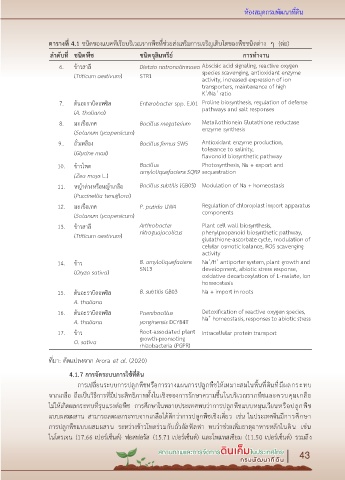
                  ตารางที่ 4.1 ชนิดของแบคทีเรียบริเวณรากพืชที่ช่วยส่งเสริมการเจริญเติบโตของพืชชนิดต่าง  ๆ  (ต่อ)

                  ลำดับที่  ชนิดพืช              ชนิดจุลินทรีย์                      การทำงาน
                     6.    ข้าวสาลี              Dietzia natronolimnaea  Abscisic acid signaling, reactive oxygen
                           (Triticum aestivum)   STR1                  species scavenging, antioxidant enzyme

                                                                       activity, increased expression of ion
                                                                       transporters, maintenance of high
                                                                        +
                                                                            +
                                                                       K /Na  ratio
                     7.    ต้นอะราบิดอพซิส       Enterobacter spp. EJ01   Proline biosynthesis, regulation of defense
                           (A. thaliana)                               pathways and salt responses

                     8.    มะเขือเทศ             Bacillus megaterium   Metallothionein Glutathione reductase
                           (Solanum lycopersicum)                      enzyme synthesis
                     9..  ถั่วเหลือง             Bacillus firmus SW5   Antioxidant enzyme production,
                           (Glycine max)                               tolerance to salinity,
                                                                       flavonoid biosynthetic pathway
                     10.  ข้าวโพด                Bacillus              Photosynthesis, Na + export and
                           (Zea mays L.)         amyloliquefaciens SQR9 sequestration
                     11.  หญ้าด่างหรือหญ้าเกลือ  Bacillus subtilis (GB03)  Modulation of Na + homeostasis

                           (Puccinellia tenuiflora)

                     12.  มะเขือเทศ              P. putida UW4         Regulation of chloroplast import apparatus
                           (Solanum lycopersicum)                      components
                     13.  ข้าวสาลี               Arthrobacter          Plant cell wall biosynthesis,
                           (Triticum aestivum)   nitroguajacolicus     phenylpropanoid biosynthetic pathway,
                                                                       glutathione-ascorbate cycle, modulation of
                                                                       celular osmotic balance, ROS scavenging
                                                                       activity
                                                                         +
                                                                            +
                     14.  ข้าว                   B. amyloliquefaciens  Na /H  antiporter system, plant growth and
                           (Oryza sativa)        SN13                  development, abiotic stress response,
                                                                       oxidative decarboxylation of L-malate, Ion
                                                                       homeostasis
                     15.  ต้นอะราบิดอพซิส        B. subtilis GB03      Na + import in roots
                           A. thaliana
                     16.  ต้นอะราบิดอพซิส        Paenibacillus         Detoxification of reactive oxygen species,
                                                                         +
                           A. thaliana           yonginensis DCY84T    Na  homeostasis, responses to abiotic stress
                     17.  ข้าว                   Root-associated plant   Intracellular protein transport
                           O. sativa             growth-promoting
                                                 rhizobacteria (PGPR)
                  ที่มา: ดัดแปลงจาก Arora et al. (2020)


                         4.1.7 การจัดระบบการใช้ที่ดิน
                           การเปลี่ยนระบบการปลูกพืชหรือการวางแผนการปลูกพืชให้เหมาะสมในพื้นที่ดินที่มีผลกระทบ
                  จากเกลือ ถือเป็นวิธีการที่มีประสิทธิภาพทั้งในเชิงของการรักษาความชื้นในบริเวณรากพืชและควบคุมเกลือ
                  ไม่ให้เกิดผลกระทบที่รุนแรงต่อพืช  การศึกษาในหลายประเทศพบว่าการปลูกพืชแบบหมุนเวียนหรือปลูกพืช
                  แบบผสมผสาน  สามารถลดผลกระทบจากเกลือได้ดีกว่าการปลูกพืชเชิงเดี่ยว  เช่น ในประเทศจีนมีการศึกษา

                  การปลูกพืชแบบผสมผสาน  ระหว่างข้าวโพดร่วมกับถั่วอัลฟัลฟา  พบว่าช่วยเพิ่มธาตุอาหารหลักในดิน  เช่น
                  ไนโตรเจน (17.66 เปอร์เซ็นต์)  ฟอสฟอรัส  (15.71 เปอร์เซ็นต์)  และโพแทสเซียม  (11.50 เปอร์เซ็นต์)  รวมถึง

                                                        สถานภาพและการจัดการดินเค็มในประเทศไทย           43
                                                                                    กรมพัฒนาที่ดิน

